Una campagna di FUTURE RIGHTS APS
ContattiRecupera la tua password
Inserisci il tuo indirizzo email: ti invieremo una nuova password, che potrai cambiare dopo il primo accesso.
Password inviata
Controlla la tua casella email: ti abbiamo inviato un messaggio con la tua nuova password.
Potrai modificarla una volta effettuato il login.
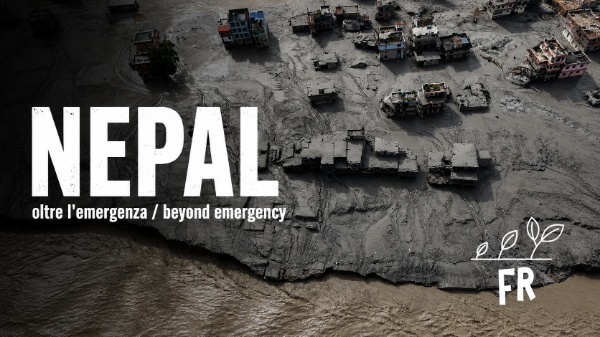
Solidarietà per il Nepal: Oltre l'Alluvione_Solidarity for Nepal: Beyond the Flood
- Raccolti € 370,00
- Sostenitori 5
- Scadenza 38 giorni rimanenti
- Modalità Donazione semplice Informazioni
Donazione semplice
Scegli la somma con cui vuoi sostenere il progetto e il sistema di pagamento che preferisci tra quelli disponibili. L’autore del progetto riceverà subito la tua donazione.
- Categoria Comunità & sociale
Il Progetto
SOSTIENI FUTURE RIGHTS SOSTIENI LE COMUNITà IMPATTATE_ STAND WITH US AND SUPPORT AFFECTED COMMUNITIES
(ENG VERSION TO FOLLOW)
Chi Siamo
Future Rights APS è un’organizzazione non-profit di promozione sociale, neo costituita , registrata in Italia, che opera nel rispetto delle normative del Terzo Settore. Siamo una piccola realtà unita dalla convinzione che adolescenti, giovani e comunità—soprattutto quelli emarginatɜ o a rischio—debbano essere al centro del cambiamento.
Siamo un collettivo intergenerazionale di sostenitori, professionisti, attivisti, esperti umanitari e alleati, uniti dalla convinzione che la giustizia debba essere co-creata.
In tempi di crisi, il panorama umanitario e dei diritti evolve rapidamente. Per questo, scegliamo di lavorare in modo dinamico, valorizzando chi si unisce a noi con passione e visione. Chi oggi collabora con Future Rights lo fa perché crede che il cambiamento nasca dalle persone.
Missione:
Future Rights dà forza e connette le voci di giovani e adolescenti emarginatɜ, permettendo loro di condividere esperienze, affrontare sfide e costruire soluzioni nei campi dei diritti umani, della giustizia sociale, del cambiamento climatico e della protezione.
Agiamo come catalizzatori di cambiamento sociale, lavorando al fianco di iniziative di base guidate da adolescenti e giovani – in particolare quelle create da e per giovani emarginatɜ e a rischio. Il nostro ruolo è identificare iniziative promettenti, aiutarle a crescere e generare un impatto duraturo, offrendo supporto personalizzato, creando connessioni e facilitando opportunità di finanziamenti.
Scopri chi siamo / i nostri progetti
EMERGENZA NEPAL
Il nostro impegno in Nepal non nasce con questa emergenza. Future Rights lavora già nel Paese insieme a organizzazioni della società civile locale, sostenendo adolescenti e giovani — tra cui il collettivo SAMANA della comunità Tamang — nella partecipazione, nella tutela dei diritti dell’infanzia, nell’equità di genere e nella costruzione di comunità più giuste. Parallelamente, attraverso SUMMIT, esploriamo la montagna come spazio di educazione, partecipazione e giustizia climatica, ambientale e sociale, mettendo in relazione territori e comunità montane dall’Italia al Nepal. Questo impegno si inserisce in un lavoro più ampio di Future Rights sulla giustizia ambientale e climatica per bambini, giovani e comunità maggiormente esposte agli impatti ambientali: stiamo sviluppando strumenti educativi e di advocacy che aiutino giovani e comunità a comprendere il legame tra ambiente, cambiamento climatico e diritti dell’infanzia e a trasformare questa consapevolezza in partecipazione, protezione e accountability.
ADESSO, ANCHE IN EMERGENZA, MA OLTRE L'ALLUVIONE_ COSA FACCIAMO
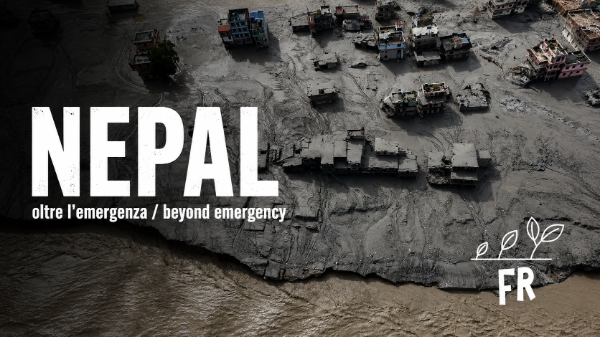
Il 26 agosto 2026 una devastante alluvione improvvisa ha colpito il Nepal settentrionale. Una potente massa di acqua, fango e detriti ha attraversato il sistema fluviale Bhote Koshi–Trishuli, distruggendo abitazioni, strade e ponti e rendendo alcune comunità difficili da raggiungere. Si stima che siano stati colpiti oltre 17.000 bambini, mentre la reale portata del disastro sta ancora emergendo.
Nei primi giorni di un’emergenza, la priorità è chiara: salvare vite.
Ricerca e soccorso, acqua potabile, riparo, cibo, assistenza sanitaria e protezione vengono prima di tutto. Comunità locali, autorità, Croce Rossa Nepalese, organizzazioni nazionali e attori umanitari internazionali sono già mobilitati per rispondere a questi bisogni immediati.
Future Rights non è una grande organizzazione di risposta alle emergenze e non vogliamo duplicare ciò che altri stanno già facendo. Tuttavia i nostri volontari ed esperti operano anche in contesti umanitari e sappiamo che se un’organizzazione locale affidabile individuerà un bisogno urgente e specifico ancora scoperto, potremo fornire un piccolo sostegno immediato.
Ma questa campagna riguarda soprattutto ciò che viene dopo.
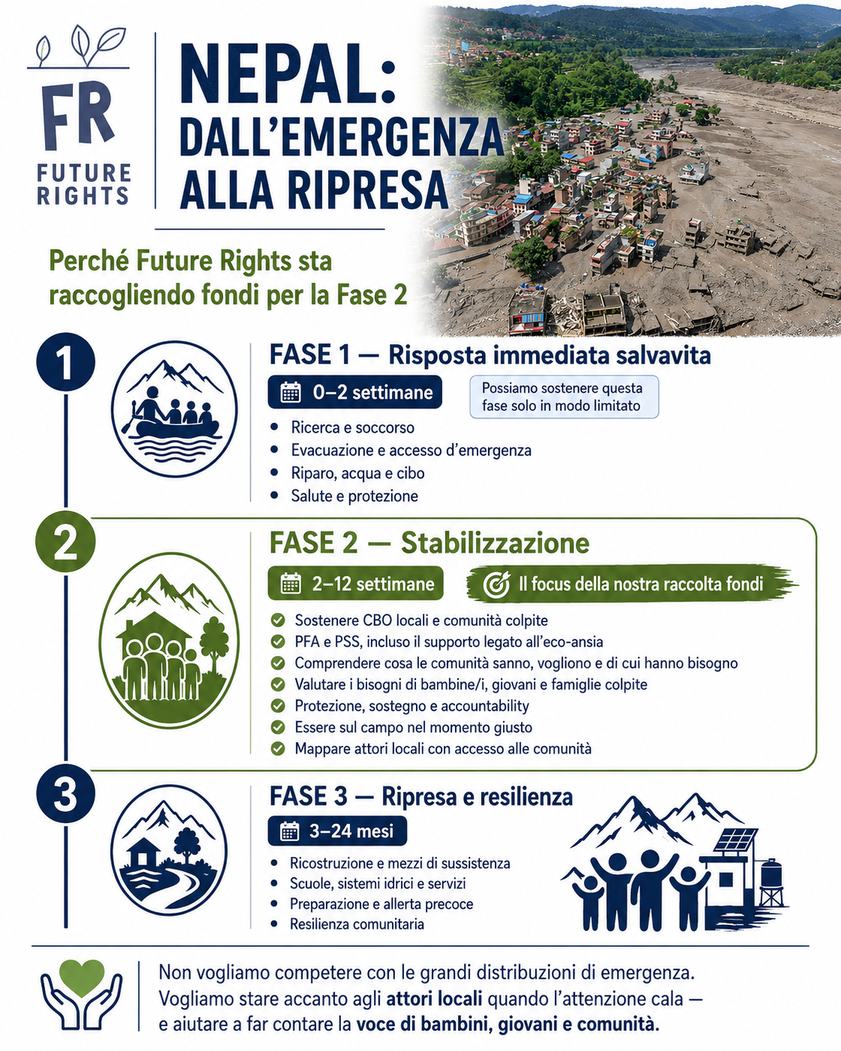
Con l’evolversi dell’emergenza, cambiano anche i bisogni. Dopo la prima risposta salvavita, emergono altre domande:
- Chi è rimasto escluso dagli aiuti?
- Come stanno affrontando l’accaduto bambini e giovani?
- Quali famiglie hanno perso l’accesso alla scuola, ai servizi o ai propri mezzi di sostentamento
- Quali rischi di protezione stanno emergendo?
- Che cosa dicono di avere bisogno le comunità colpite?
È qui che vogliamo concentrare il nostro lavoro.
La nostra priorità è la Fase 2: stabilizzazione e recupero iniziale, quando l’attenzione pubblica spesso comincia a diminuire, ma le comunità continuano a convivere con perdita, sfollamento e incertezza.
Vogliamo lavorare con CBO, ONG locali, gruppi giovanili e strutture comunitarie per sostenere:
supporto psicosociale e Primo Soccorso Psicologico;
partecipazione e protezione di bambini e giovani;
ascolto delle comunità colpite e comprensione delle loro priorità;
mappatura di attori locali affidabili in grado di raggiungere le aree colpite;
individuazione dei bisogni ancora scoperti e sostegno a iniziative guidate localmente.
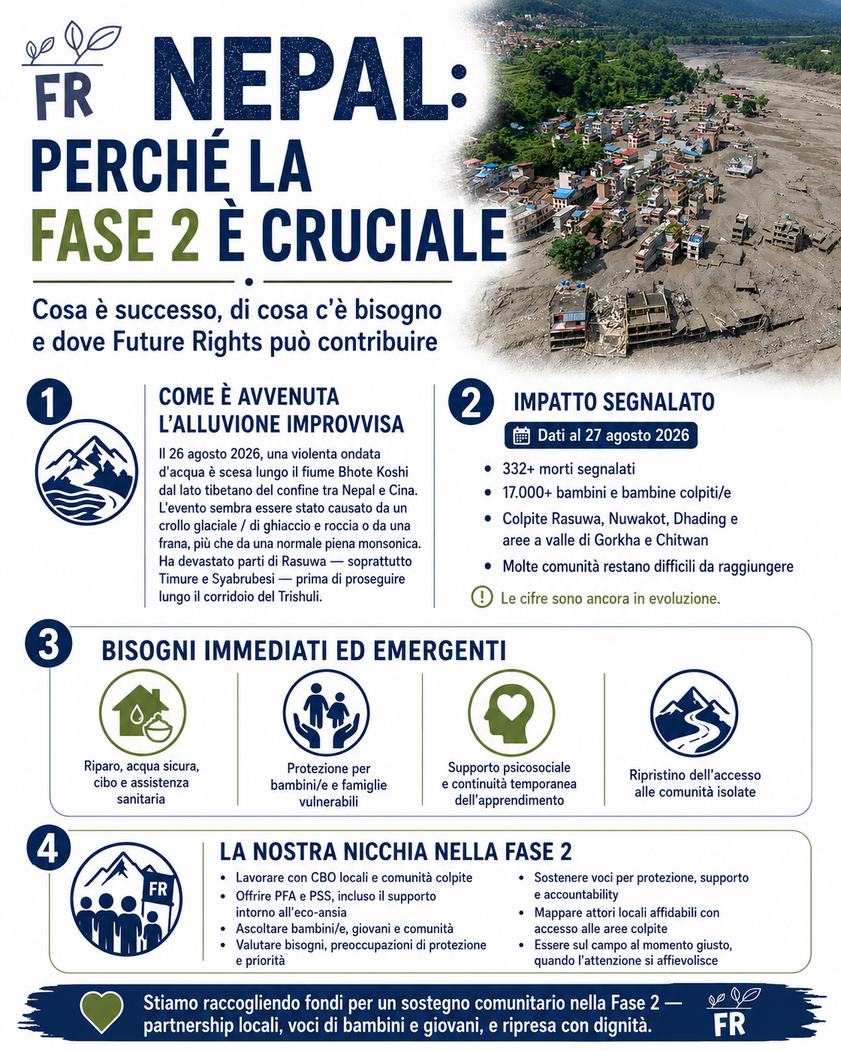
I bisogni sul terreno sono molti e cambiano nel tempo. Il nostro ruolo non è rispondere a tutti.
La nostra responsabilità è capire dove un contributo piccolo e flessibile possa davvero fare la differenza, senza duplicare ciò che altri stanno già facendo.
Perché non comprare semplicemente cibo e coperte adesso?
Perché in un’emergenza è importante intervenire rapidamente, ma è altrettanto importante intervenire nel modo giusto.
Dopo una grande calamità, le donazioni individuali, anche se mosse dalle migliori intenzioni, possono arrivare nella quantità sbagliata, nel posto sbagliato o nel momento sbagliato. Possono sovraccaricare magazzini e trasporti o duplicare aiuti già disponibili.
Il Nepal lo ha già sperimentato. Dopo il terremoto del 2015, grandi quantità di cibo donato rimasero inutilizzate nei magazzini e parte delle scorte finì per deteriorarsi.
La lezione è semplice: non decidere la soluzione prima di aver compreso il bisogno.
Prima di spendere, vogliamo sapere: Che cosa serve davvero? Dove? A chi? Chi sta già intervenendo? E che cosa manca ancora?
Per questo stiamo raccogliendo un fondo flessibile, invece di promettere che ogni donazione verrà immediatamente trasformata in un bene prestabilito.
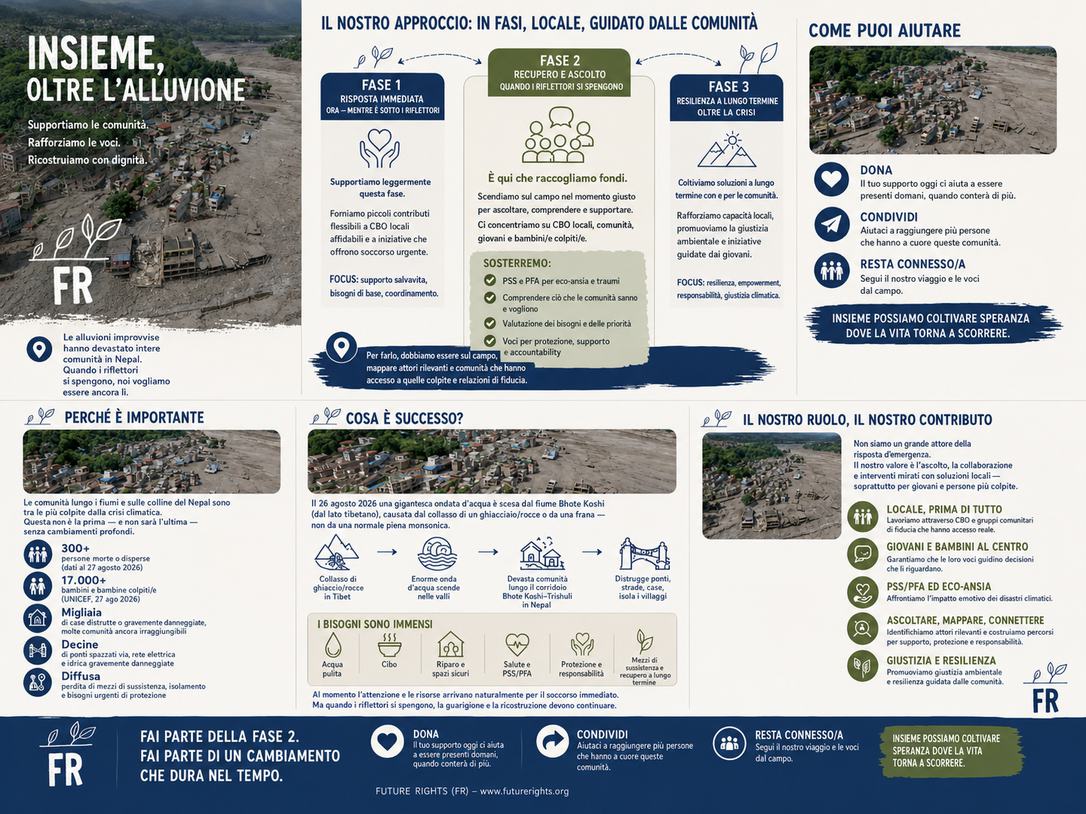
Cosa sosterrà la tua donazione?
Una piccola parte del fondo potrà sostenere un bisogno locale urgente e chiaramente identificato durante la fase immediata.
Ma il nostro obiettivo principale è avere risorse disponibili per le settimane e i mesi successivi, quando i bisogni saranno più chiari e l’emergenza comincerà a scomparire dai riflettori.
La tua donazione ci aiuterà a condurre una mappatura sul posto , individuare organizzazioni locali e comunità affidabili, comprendere i bisogni emergenti nel campo ascoltando le voci degli esperti sul cambiamento climatico, impatto ambientale e centri di ricerca quali il Centro Internazionale per lo Sviluppo Integrato delle Montagne (ICIMOD), ONG internazionali e locali già operativi nel campo della riduzione dei rischi legati a disastri naturali, supporto psicosociale, protezione minori non accompagnati e in assenza di cure parentali, e soprattutto ascolteremo le voci delle comunità, giovani impattati per sostenere e rafforzare le risposte giuste guidate localmente.
Sul terreno al momento giusto
Ascoltare, incontrare gli attori locali e capire dove il nostro contributo può essere realmente utile.
Il nostro impegno
- Prima cercheremo di comprendere il bisogno, individuare partner locali affidabili e verificare cosa stanno già facendo gli altri attori.
- Sosterremo poi iniziative nelle quali il nostro contributo possa davvero fare la differenza e condivideremo aggiornamenti su come i fondi saranno utilizzati.
I primi giorni di un’emergenza ricevono la maggiore attenzione. La ripresa dura molto più a lungo.
Dona. Condividi. Rimani connesso.
PER EVENTUALI PROBLEMI CON PAYPAL ACCEDERE QUESTO LINK
Who We Are
Future Rights APS is a newly established non-profit Social Promotion Association registered in Italy and operating within the framework of Italian Third Sector legislation. We are a small organisation united by the belief that adolescents, young people and communities—especially those who are marginalised or at risk—should be at the centre of change.
We are an intergenerational collective of advocates, practitioners, activists, humanitarian professionals and allies, brought together by the belief that justice must be co-created.
In times of crisis, the humanitarian and human rights landscape changes rapidly. This is why we choose to work dynamically, building on the commitment, expertise and vision of the people who join us. Those who work with Future Rights do so because they believe that change starts with people.
Our Mission
Future Rights empowers and connects the voices of marginalised adolescents and young people, enabling them to share their experiences, address the challenges they face and build solutions in the fields of human rights, social justice, climate change and protection.
We act as catalysts for social change, working alongside grassroots initiatives led by adolescents and young people or affected communities—particularly those who are marginalised or at risk. Our role is to identify promising initiatives, help them grow and create lasting impact through tailored support, connections and access to funding opportunities.
Learn more about us / Explore our projects
NEPAL EMERGENCY
Our commitment to Nepal did not begin with this emergency.
Future Rights already works in Nepal alongside local civil society organisations, supporting adolescents and young people—including the SAMANA collective from the Tamang community—in strengthening youth participation, child rights, gender equality and more just communities.
Through SUMMIT, we are also exploring mountain environments as spaces for education, participation and climate, environmental and social justice, connecting mountain territories and communities in Italy and Nepal.
This forms part of Future Rights’ broader commitment to environmental and climate justice for children, young people and communities who are most exposed to environmental harm and the impacts of climate change. We are currently developing educational and advocacy tools to help young people and communities understand the connections between the environment, climate change and children’s rights—and turn that understanding into participation, protection and accountability.
NOW, IN THE EMERGENCY — BUT BEYOND THE FLOOD
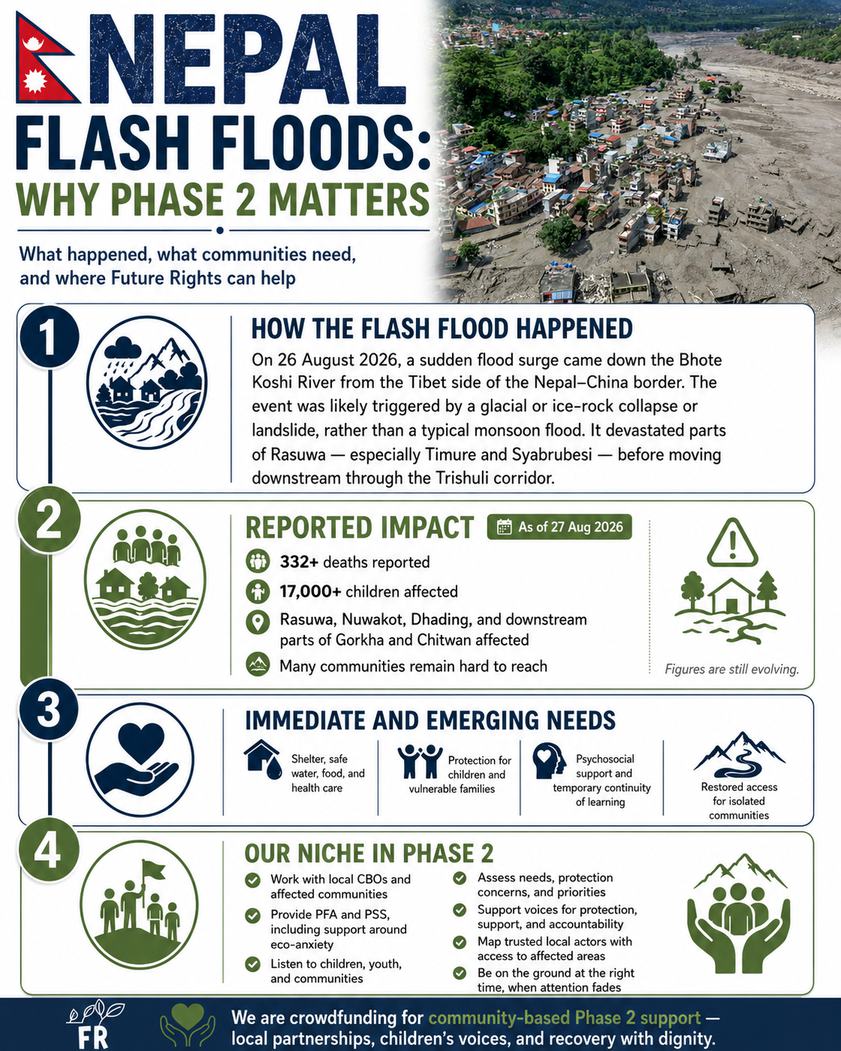
On 26 August 2026, a devastating flash flood struck northern Nepal.
A powerful surge of water, mud and debris swept through the Bhote Koshi–Trishuli river system, destroying homes, roads and bridges and leaving some communities extremely difficult to reach. More than 17,000 children are estimated to have been affected, while the full scale of the disaster is still emerging.
In the first days of an emergency, the priority is clear: saving lives.
Search and rescue, safe drinking water, emergency shelter, food, health care and protection come first. Local communities, authorities, the Nepal Red Cross Society, national organisations and international humanitarian actors are already mobilising to meet these immediate needs.
Future Rights is not a large-scale emergency response organisation, and we do not want to duplicate what others are already doing. At the same time, our volunteers and experts also have experience working in humanitarian settings. If a trusted local organisation identifies a specific and urgent gap that is not being covered, we may therefore provide limited immediate support.
But this campaign is mainly about what comes next.
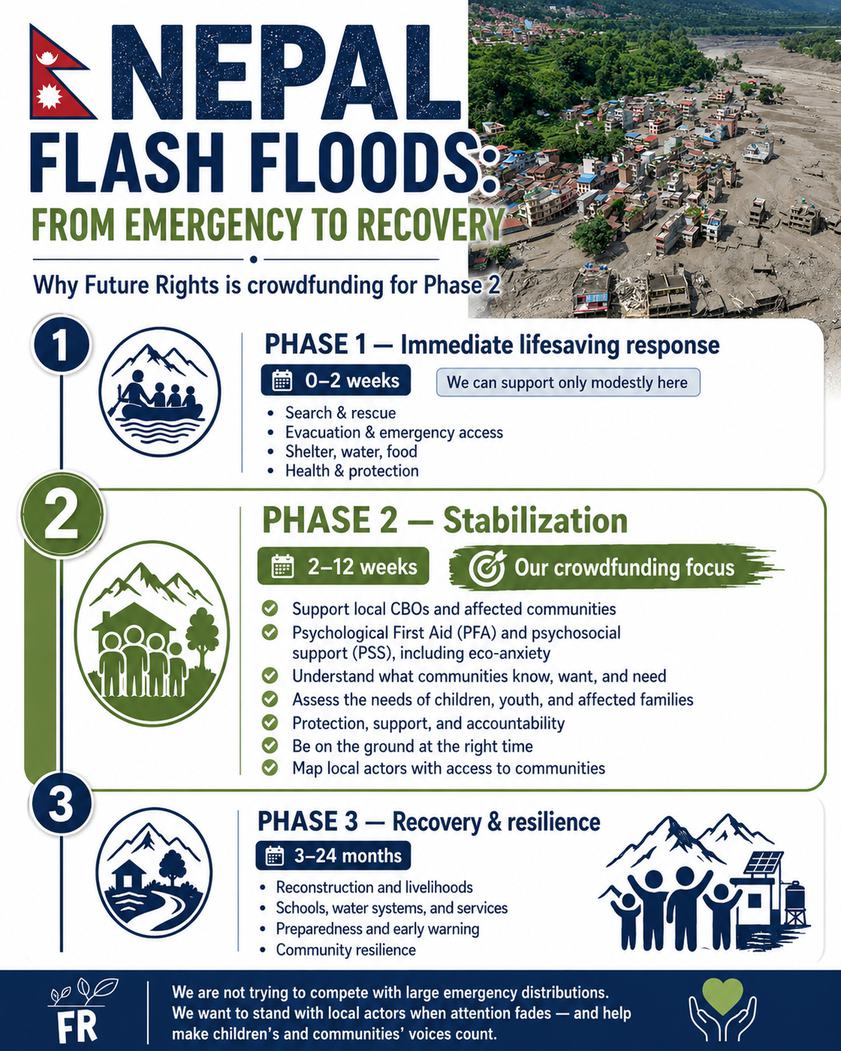
As an emergency evolves, needs also change. Once the immediate lifesaving response is underway, other questions begin to emerge:
- Who has been missed or excluded from assistance?
- How are children and young people coping with what has happened?
- Which families have lost access to education, essential services or their livelihoods?
- What protection risks are emerging?
- What do affected communities themselves say they need?
This is where we want to concentrate our efforts.
Our priority is Phase 2: stabilisation and early recovery—the period when public attention often begins to fade, while communities continue to live with loss, displacement and uncertainty.
We want to work with CBOs, local NGOs, youth groups and community structures to support:
- psychosocial support and Psychological First Aid (PFA);
- the participation and protection of children and young people;
- listening to affected communities and understanding their priorities;
- mapping trusted local actors with genuine access to affected areas;
- identifying unmet needs and supporting locally led initiatives.
Needs on the ground are many, and they change over time. Our role is not to respond to all of them.
Our responsibility is to understand where a small, flexible contribution can genuinely make a difference without duplicating what others are already doing.
Why not simply buy food and blankets now?
Because in an emergency, responding quickly matters—but responding appropriately matters just as much.
Following a major disaster, individual donations, even when driven by the best intentions, can arrive in the wrong quantities, in the wrong places or at the wrong time. They can overwhelm storage and transport capacity or duplicate assistance that is already available.
Nepal has experienced this before. After the 2015 earthquake, large quantities of donated food remained unused in warehouses, and some stocks eventually deteriorated.
The lesson is simple: do not decide on the solution before understanding the need.
Before spending funds, we want to know:
What is genuinely needed? Where? By whom? Who is already responding? And what is still missing?
This is why we are raising a flexible response fund, rather than promising that every donation will immediately be converted into a predetermined item.
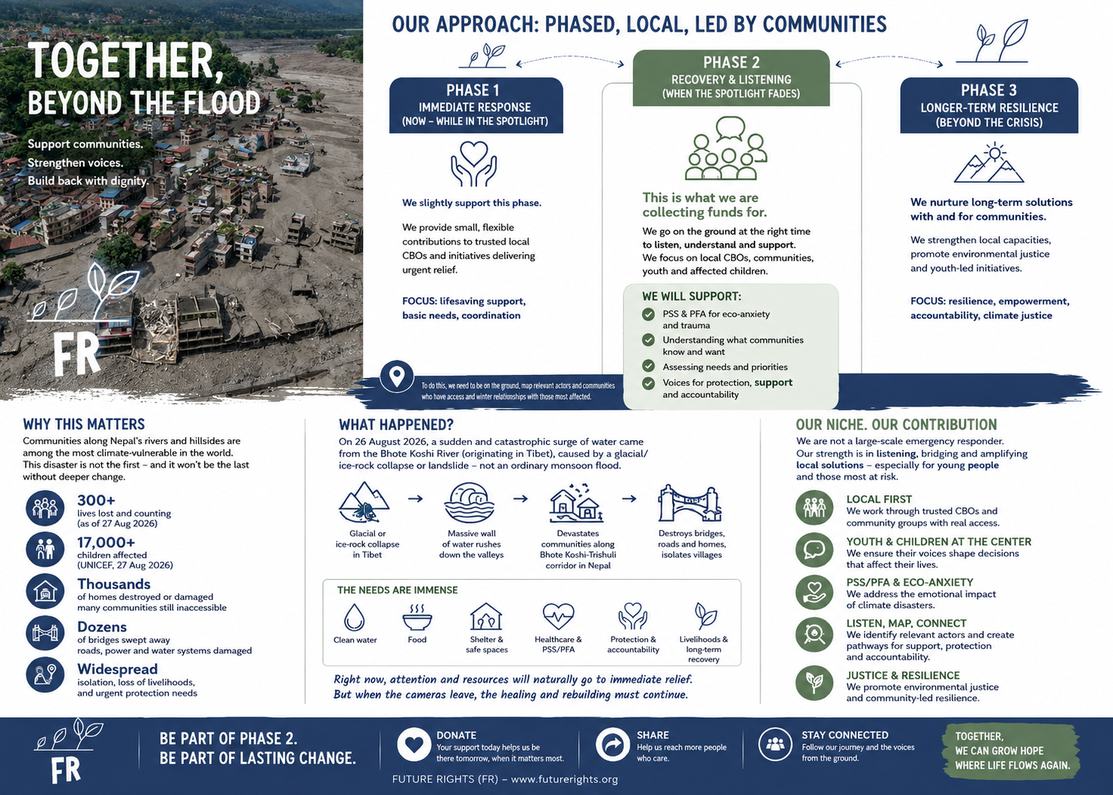
What will your donation support?
A small proportion of the fund may be used to respond to an urgent and clearly identified local need during the immediate emergency phase.
Our main objective, however, is to ensure that resources are available in the weeks and months ahead—when needs become clearer and the emergency begins to disappear from the headlines.
Your donation will help us carry out on-the-ground mapping and engagement, identify trusted local organisations and community actors, and better understand emerging needs.
We will listen to and connect with experts working on climate change, environmental impacts and mountain ecosystems, including research institutions such as the International Centre for Integrated Mountain Development (ICIMOD); international and local NGOs already working on disaster risk reduction, psychosocial support and child protection, including support for unaccompanied and separated children and children without parental care.
Most importantly, we will listen directly to affected communities, children and young people themselves.
The aim is to understand where gaps remain and support the most appropriate locally led responses, rather than arriving with predetermined solutions.
On the ground, at the right time
To listen. To meet local actors. To understand where our contribution can genuinely be useful.
Our Commitment
- We will first seek to understand the needs, identify trusted local partners and assess what other organisations and responders are already providing.
- We will then support initiatives where our contribution can genuinely add value, and we will share updates on how the funds are used.
The first days of an emergency receive the greatest attention. Recovery lasts much longer.
Donate. Share. Stay connected.
FOR ANY PROBLEMS WITH PAYPAL KINDLY USE THIS LINK
Questo progetto ha segnalato obiettivi di sviluppo sostenibile
Gli obiettivi di sviluppo sostenibile (SDGs) costituiscono una serie di 17 obiettivi concordati dall'Organizzazione delle Nazioni Unite.
10. Ridurre le disuguaglianze
Ridurre le diseguaglianze: ridurre le disuguaglianze all'interno e tra i paesi;
13. Agire per il clima
Lotta contro il cambiamento climatico: adottare misure urgenti per combattere il cambiamento climatico e le sue conseguenze.
16. Pace, giustizia e istituzioni forti
Pace e giustizia: promuovere lo sviluppo sostenibile.
Commenti (0)