Una campagna di Anna Marino
ContattiRecupera la tua password
Inserisci il tuo indirizzo email: ti invieremo una nuova password, che potrai cambiare dopo il primo accesso.
Password inviata
Controlla la tua casella email: ti abbiamo inviato un messaggio con la tua nuova password.
Potrai modificarla una volta effettuato il login.
Aquagreen
- Raccolti € 0,00
- Obiettivo € 33.200,00
- Sostenitori 0
- Scadenza 119 giorni rimanenti
- Modalità Tutto o niente Informazioni
Tutto o niente
Il tuo contributo servirà a sostenere un progetto ambizioso che deve essere sviluppato. Seleziona il metodo di pagamento che preferisci tra quelli disponibili e pre-autorizza la donazione. I fondi verranno prelevati da PayPal o Lemon Way (carte) a scadenza e solo se il progetto ha raggiunto o superato l’obiettivo. Ricorda di salvare un metodo di pagamento che per allora sia valido e con fondi disponibili. Se utilizzi una carta virtuale generala "di durata" e non "usa e getta".
- Categoria Food & agricoltura
Il Progetto
AQUAGREEN
A circular system for producing food, saving water and regenerating the land
The problem I’m starting with
Today, climate change is no longer an abstract issue: it is already transforming the way we live, farm and inhabit the land.
In Abruzzo, as in many inland areas of Italy, water scarcity, changes in rainfall patterns, increasingly prolonged periods of drought and rural depopulation are undermining traditional agricultural systems and the ability of local communities to produce food in a stable and sustainable manner.
Faced with this situation, simply adapting is not enough: we need to imagine and build new models capable of using water more efficiently, making the most of local resources and creating more resilient supply chains.
Aquagreen was born precisely out of this need.
It is a project that combines science, sustainability and innovation to demonstrate that it is possible to produce food in a circular way, reducing waste and increasing the self-sufficiency of local areas.

About me
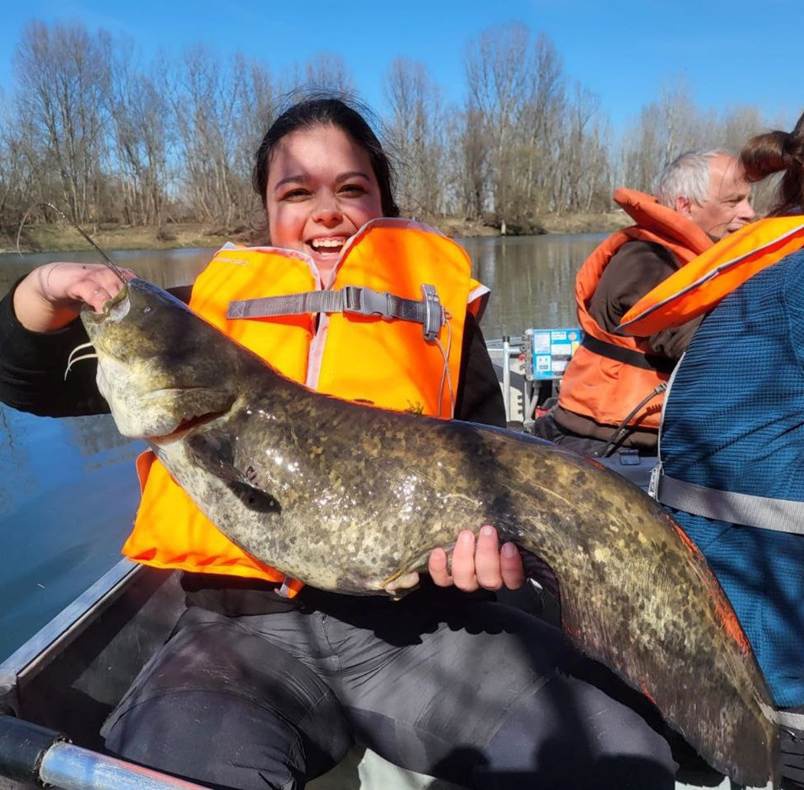
My name is Anna Marino (https://sites.google.com/view/anna-marino-idrobiologa) and I am a hydrobiologist and postdoctoral researcher in freshwater ecology at the University of Turin. I grew up amidst the rolling hills of Teramo and the rugged mountains of the ‘Sleeping Beauty’ region. Abruzzo has laid the deep foundations that have shaped my professional path.
This project is promoted by me on a personal basis, and I am the sole beneficiary of the funds raised through this campaign. All contributions will be managed directly by me and used exclusively for the development and scientific implementation of the Aquagreen project.
For years I have been working on aquatic ecosystems, climate change, biodiversity and environmental monitoring. My scientific work focuses in particular on the effects of human and climatic pressures on riverine environments, using an approach that integrates field research, experimentation and advanced ecological analysis.
Throughout my career, I have collaborated with universities, research bodies, environmental agencies and local organisations, developing an increasingly clear vision: scientific research must be able to move beyond the laboratory and become a practical tool for tackling the real-world problems faced by communities.
Aquagreen is exactly that:
a practical, applied project, born from the convergence of scientific expertise, ecological awareness and a desire to make a positive impact on the local area.
Why Abruzzo
Abruzzo is an extraordinary region, but also a fragile one.
In recent years, it has been facing increasingly evident problems linked to water availability, the vulnerability of rural areas and the gradual loss of human presence in inland regions.
In many hilly and mountainous areas, water is an increasingly fragile resource: rainfall is less regular, extreme weather events are on the rise, irrigation infrastructure is often lacking or insufficient, and the abandonment of farming makes everything even more difficult.
In this context, creating a system capable of:
• collecting and reusing rainwater,
• producing food with minimal water consumption,
• making the most of local resources and organic waste,
• providing training and fostering community involvement,
means offering a practical solution to a real need. 
(Photo village of Castiglione Messer Raimondo, Teramo, Abruzzo, Italy)
Why Casale il Baronetto?
Aquagreen will be launched at Casale il Baronetto (https://www.casaleilbaronetto.it/en), in Castiglione Messer Raimondo, in the province of Teramo.
Casale il Baronetto is not merely an accommodation facility: it is a place that has for years been putting into practice a way of life based on sustainability, self-sufficiency, respect for nature and an authentic connection with the local area.
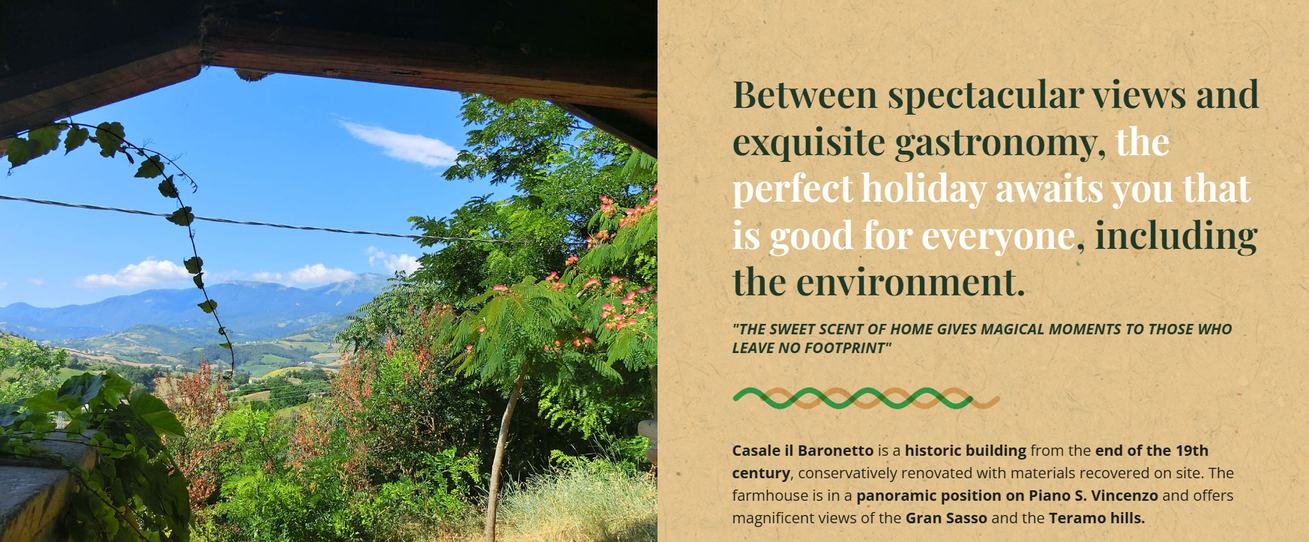
Located in a panoramic location between the Gran Sasso and the Teramo hills, Casale il Baronetto is a historic late 19th-century building, conservatively restored using materials recovered on site. Here, rainwater harvesting, energy self-sufficiency, natural farming and ‘slow hospitality’ are already practised, in line with the values of ecotourism and rural regeneration.
It is the ideal location for Aquagreen because it already embodies, in its daily practice, the principles that the project aims to reinforce: circularity, simplicity, self-sufficiency, environmental education and local roots.
Within this project, Casale il Baronetto provides the physical space and technical support necessary for the implementation of the pilot system. However, it is important to clarify that it does not receive any of the funds raised through this campaign, which are managed directly by me.
What is Aquagreen?
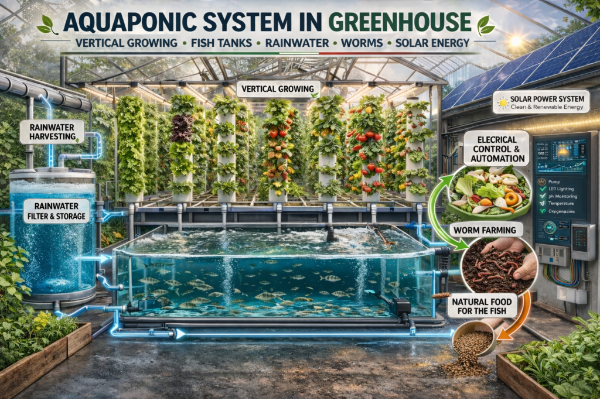
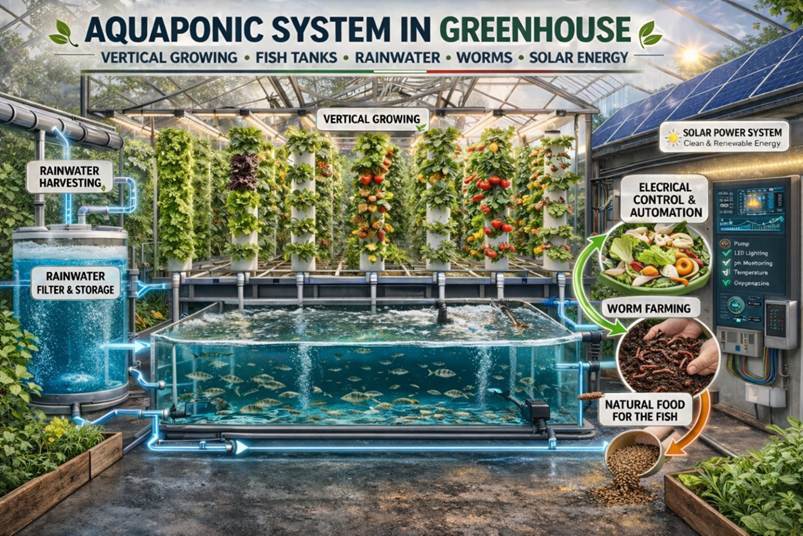
Aquagreen is an integrated, circular aquaponics system designed to produce vegetables and animal protein sustainably, whilst drastically reducing water consumption and the use of external inputs.
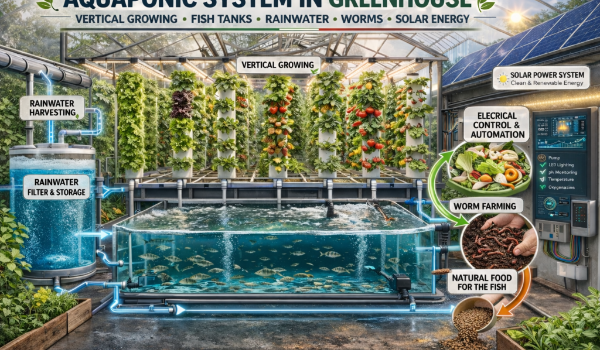
At the heart of the project is a closed-loop aquaponics greenhouse, where fish farming and hydroponic cultivation work in synergy:
• the fish produce nutrients;
• these nutrients feed the plants grown in the greenhouse;
• the plants, in turn, help to purify the water;
• the water is then returned to the system and reused.
This allows over 95% of the water to be reused, making the system extremely efficient and particularly suitable for contexts where water resources are limited.
How it works
Water
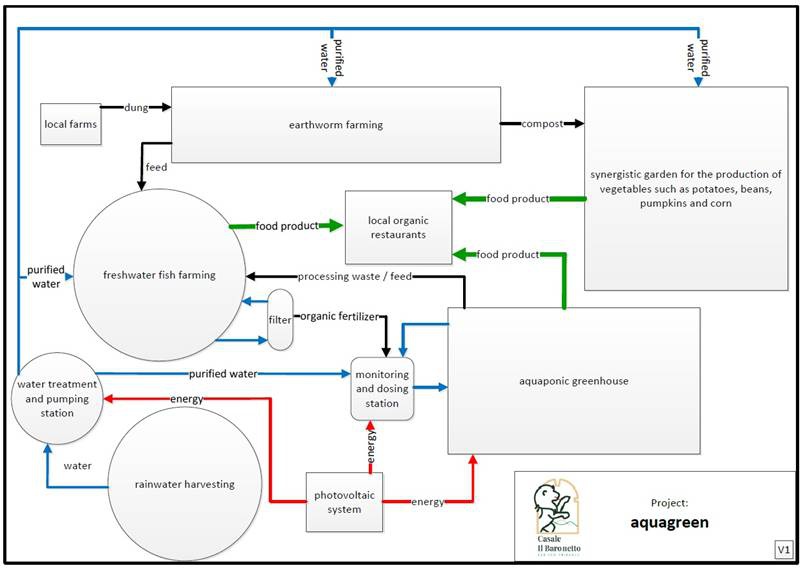
The water used in the system will come mainly from rainwater collected in special tanks, which is filtered and treated before use.
In this way, Aquagreen reduces dependence on conventional sources and establishes a more resilient and self-sufficient management model.
Fish
The species chosen is the tench (Tinca tinca), a native fish well-adapted to our climatic conditions, hardy and compatible with a low-impact ecological approach. Choosing a local species reduces environmental risks and strengthens the link between the project and the local area.
Crops
Vegetables will be grown in the greenhouse using a hydroponic system fed by nutrients produced by the fish farm.
Next to the greenhouse, a synergistic vegetable garden will complement production with seasonal crops unsuitable for the protected environment.
Nutrients and compost
The system will be integrated with a composter, fed by cattle manure from local sustainable farms, and with earthworm farming. The earthworms serve a dual purpose: they enrich the soil and provide a natural source of food for the fish.
In this way, organic waste is transformed into resources, helping to further reduce the use of industrial feed and chemical fertilisers.
Energy
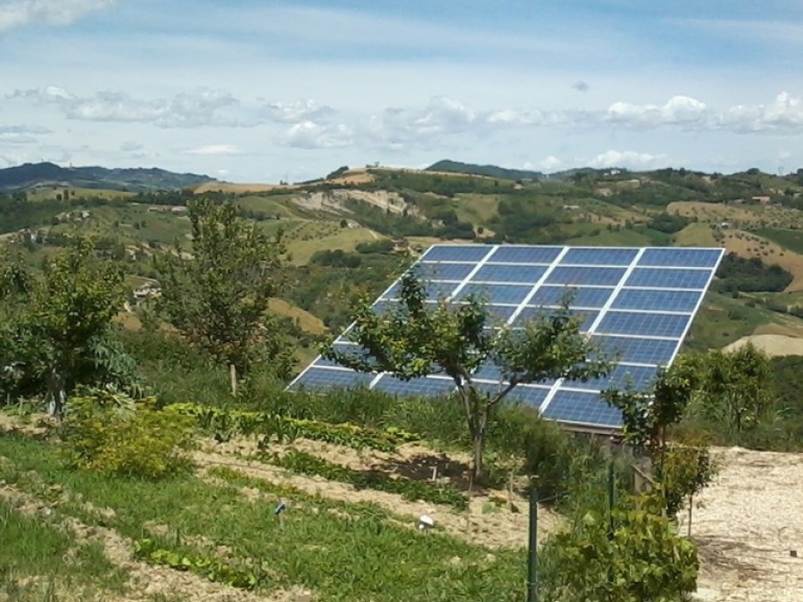
The entire facility will be powered by a photovoltaic system with storage, ensuring energy self-sufficiency and minimising environmental impact.
Monitoring
Sensors and control systems will enable the monitoring of key parameters such as temperature, pH, dissolved oxygen and water quality, ensuring biological balance, safety and system continuity.
Why this project is important
Aquagreen is not just a greenhouse.
It is a demonstration model that aims to show, in practical terms, that a different kind of agriculture is possible.
A form of agriculture that:
• uses less water,
• recycles local resources,
• reduces waste and external dependencies,
• produces healthy food,
• generates knowledge,
• can be replicated in other vulnerable rural areas.
It is a project that addresses multiple dimensions simultaneously: environmental, social and economic.
The impact I aim to create
With Aquagreen, I aim to:
• demonstrate the viability of an innovative and replicable agroecological system;
• contribute to a more responsible and sustainable use of water;
• create an active hub for rural regeneration;
• strengthen short supply chains, local production and a culture of sustainability;
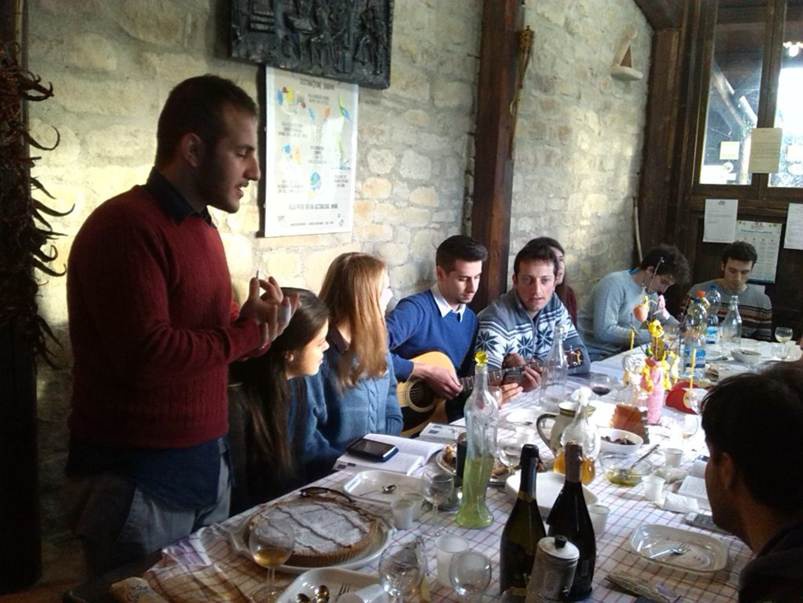
• transform Casale il Baronetto into an even more vibrant place, capable of combining hospitality, environmental education and practical experimentation.
A vision that therefore starts from a specific place, but looks far ahead. Although Aquagreen originated in Abruzzo, at Casale il Baronetto, its ultimate aim is to inspire other communities, other farms and other regions that are currently facing the same vulnerabilities.
Why I'm asking for your support
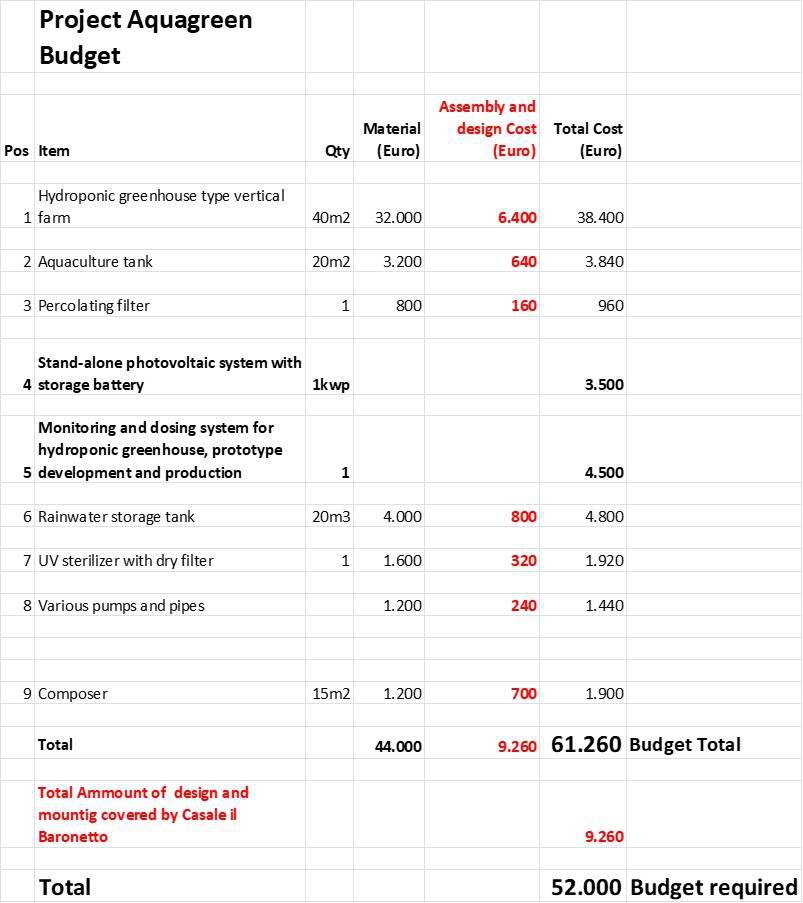
A project like this requires vision, hard work, expertise and investment. The estimated budget for the completion of the entire project is €61,260. All individual components are listed as specific costs, including design and installation. Casale il Baronetto possesses the necessary expertise to design and assemble the entire structure, drawing on its engineering, architectural and biological knowledge. Consequently, the total cost of this work is fully covered by Casale il Baronetto and deducted from the total investment.
How the funds will be used
The funds raised through this campaign will be directly managed by me and will support the pilot phase of the Aquagreen project. In particular, they will cover:
• materials for the aquaponic greenhouse (tanks, pipes, growing systems)
• monitoring equipment (sensors for water quality, oxygen, pH, temperature)
• initial biological components (fish stock, plants, substrates)
• water collection and filtration systems
• partial contribution to photovoltaic system components
• consumables and setup costs necessary for the experimental phase
All funds will be used exclusively for the development, implementation and scientific testing of the Aquagreen system.
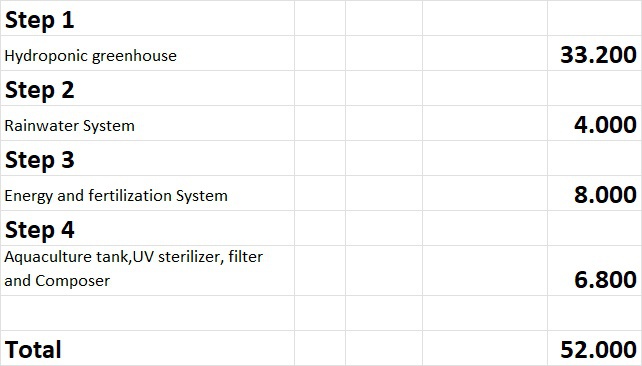
To make this possible, I have chosen to build it in stages, in a progressive and transparent manner.
Each stage will be self-contained and functional, but will contribute to the creation of a comprehensive, efficient system that is built to last.
Supporting Aquagreen means contributing not only to the construction of an aquaponics greenhouse, but also to the creation of a model that brings together:
• sustainable water management,
• circular food production,
• accessible innovation,
• land conservation,
• environmental education,
• a future for rural areas.
Help us make it happen
Supporting Aquagreen means choosing to invest in a concrete vision of the future:
a future in which water, food, the land and communities are once again part of the same balance.
With your contribution, I can turn this idea into a living, useful and shared reality.
Questo progetto ha segnalato obiettivi di sviluppo sostenibile
Gli obiettivi di sviluppo sostenibile (SDGs) costituiscono una serie di 17 obiettivi concordati dall'Organizzazione delle Nazioni Unite.
7. Energia pulita e sostenibile
Energia rinnovabile e accessibile: assicurare la disponibilità di servizi energetici accessibili, affidabili, sostenibili e moderni per tutti.
12. Consumo e produzione responsabili
Utilizzo responsabile delle risorse: garantire modelli di consumo e produzione sostenibili.
13. Agire per il clima
Lotta contro il cambiamento climatico: adottare misure urgenti per combattere il cambiamento climatico e le sue conseguenze.
Commenti (0)